STAT 218 - Week 5, Lecture 3
February 7th, 2024

The formula that we have used so far is
\[ SE_{\bar{Y}} = \frac{s}{\sqrt{n}} \]
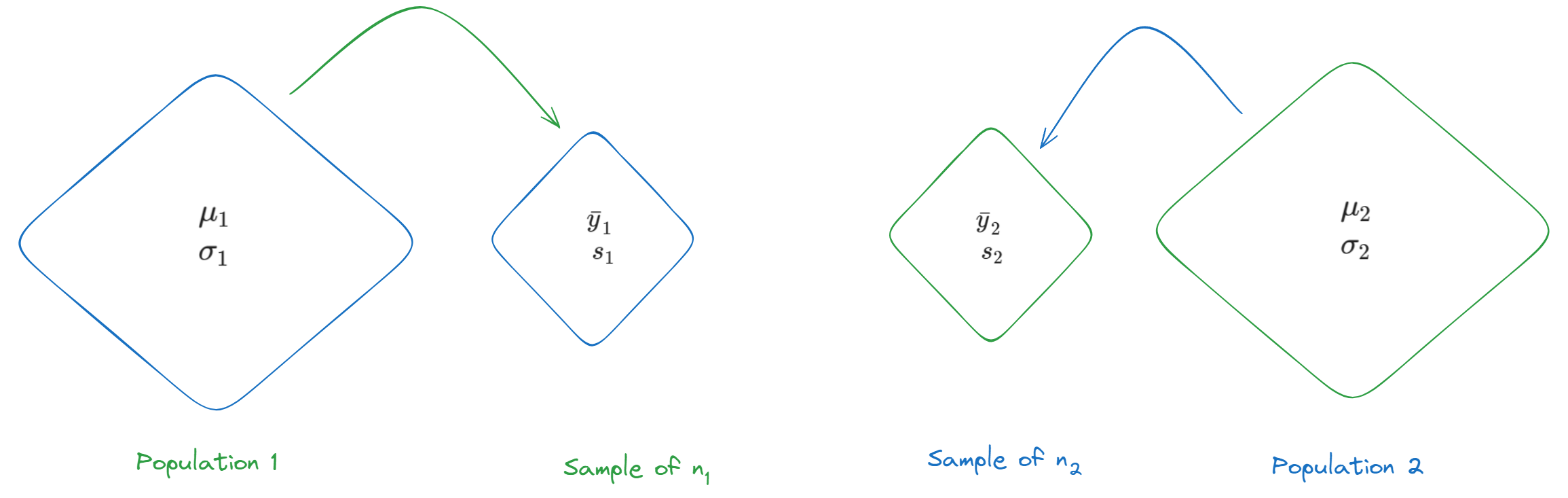
Naturally, we can say that taking the difference between two sample means is an estimate of the quantity (\(\mu_1\) - \(\mu_2\)).
However, the formula for the standard error of the difference (\(\bar{Y}_1\) - \(\bar{Y}_2\)) is a little different from what we initially thought.
\[ SE_{\bar{Y}_1 - \bar{Y}_2} = \sqrt{SE_1^2 + SE_2^2} \]
\[ SE_{\bar{Y}_1 - \bar{Y}_2} = \sqrt{ \frac {s_1^2}{n_1} + \frac {s_2^2}{n_2}} \]
\[ \\95 \% \ CI = (\bar{y} \pm t_{0.025} \ \times \ SE_{\bar{y}}) \] Let’s revise our 95% confidence interval formula for comparing two means.
\[ \\95 \% \ CI = (\bar{y_1}-\bar{y_2}) \pm t_{0.025} \times SE_{\bar{Y}_1 - \bar{Y}_2} \]
Warning
You are not responsible for calculating degrees of freedom for this chapter. It has a complex formula in your book but we either calculate that \(df\) by using computer or I give you the \(df\) value directly.
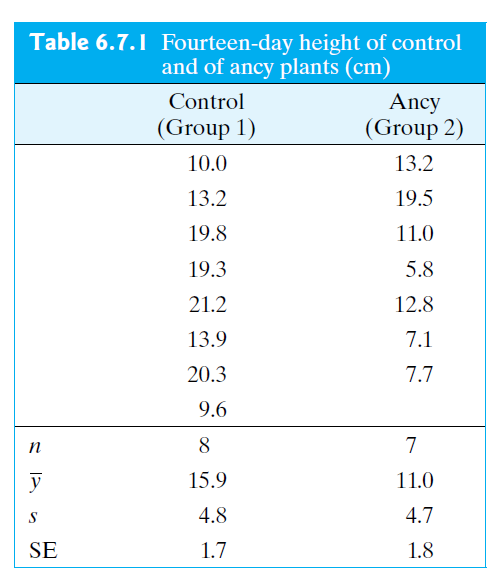
The Wisconsin Fast Plant, Brassica campestris, has a very rapid growth cycle that makes it particularly well suited for the study of factors that affect plant growth.
In one such study, 7 plants were treated with the substance Ancymidol (ancy) and were compared to 8 control plants that were given ordinary water. Heights of all of the plants were measured, in cm, after 14 days of growth.
(\(df\) for this question is calculated as 12).
Calculate 95% confidence interval for (\(\mu_1\) - \(\mu_2\))
95% CI for (\(\mu_1\) - \(\mu_2\)) is (-0.46,10.26)
Is it reasonable to believe that the substance may affect plant growth? Discuss with your neighbor
Ancymidol is a plant growth regulator that reduces plant growth by inhibiting gibberellin biosynthesis.
In our hypothetical example, we calculated 95% CI and
The confidence interval formula is valid if
the data can be regarded as coming from two independently chosen random samples,
the observations are independent within each sample, and
each of the populations is normally distributed.
If \(n_1\) and \(n_2\) are large, condition (3) is less important.
Contextual Questions:
Is it reasonable to believe that the substance may affect the plant growth?
Did we find an evidence that the substance may affect the plant growth?
Are we attempting to prove or refute anything here?
What is our primary objective or purpose in this scenario, broadly speaking?
What factors could contribute to conflicting evidence in this example?
Big Questions:
Once scientists establish a theory or law, is it subject to change over time?