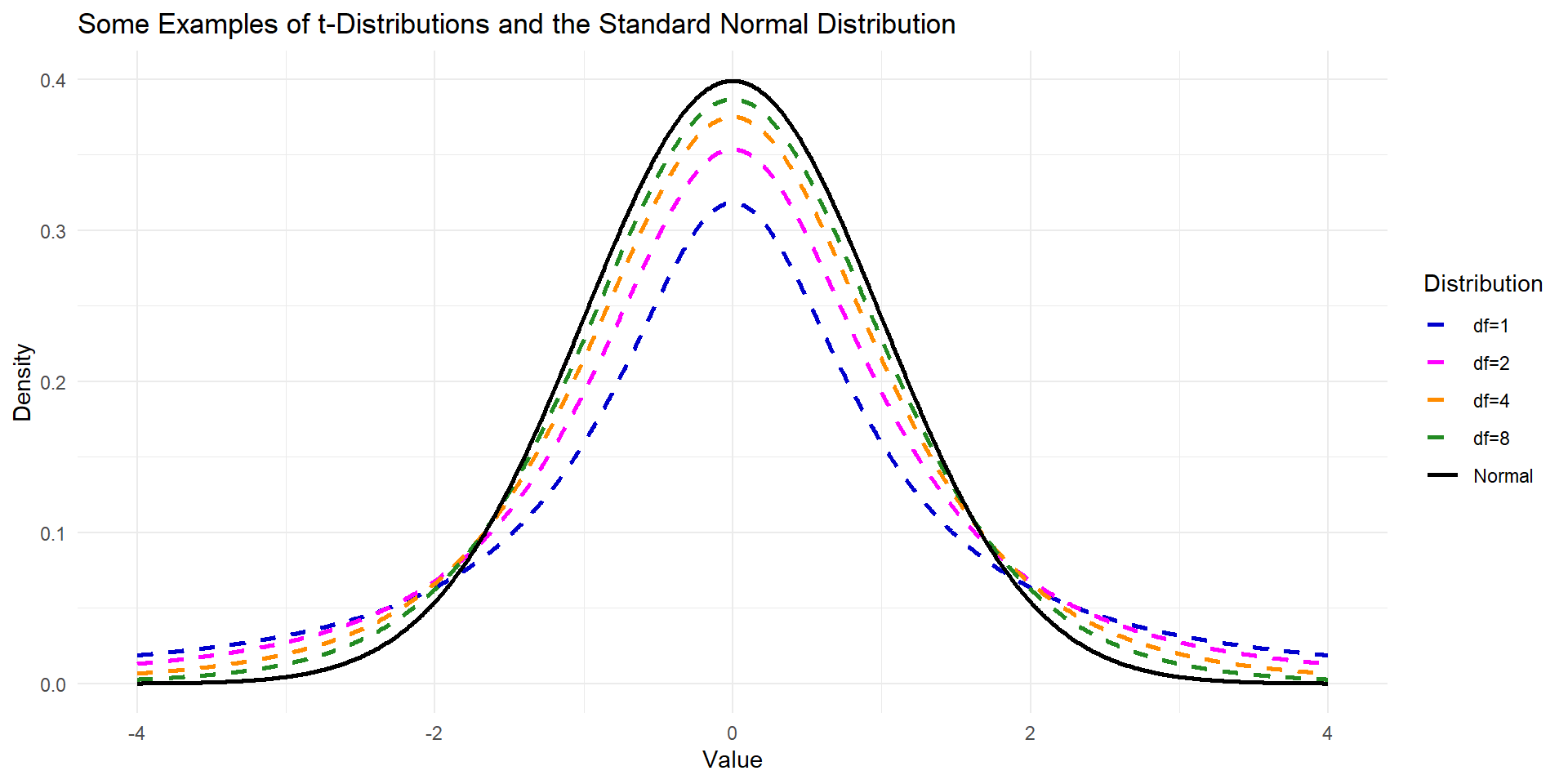
Student’s t Distribution
STAT 218 - Week 5, Lecture 2
February 6th, 2024
How to Read Table 4
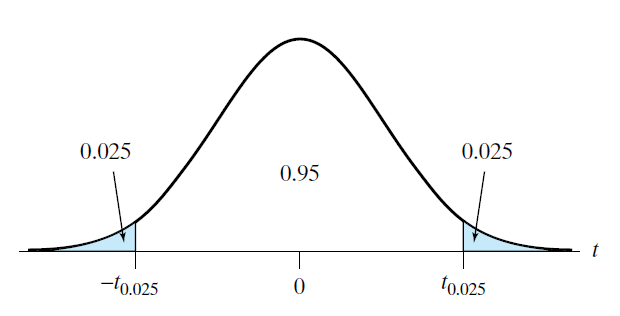
- Let’s check Table 4 in our book and see how \(t_{0.025}\) value decreases as the \(df\) increases.
- for \(df = \infty\), the value is \(t_{0.025} = 1.960\) which means that it approached the same value in Table 3 (\(Z\) Scale)
Same Example from Last Week - I
Let’s have a look wing areas of 14 male Monarch butterflies at Oceano Dunes State Park in California
- \(\bar{y} = 32.8143 \ cm^2\) and \(s= 2.4757 \ cm^2\)
Suppose we consider these 14 observations as a random sample from a population.
\[ df = n - 1 \\ df = 14 - 1 \\ df = 13 \]
From the Table 4, we find
\[ t_{0.025} = 2.160 \]

Same Example from Last Week - II
95% confidence interval (CI) for \(\mu\) can be calculated as following:
- \(\bar{y} = 32.8143 \ cm^2\) and \(s= 2.4757 \ cm^2\)
\[ \\95 \% \ CI = (\bar{y} \pm t_{0.025} \ \times \ SE_{\bar{y}}) \\95 \% \ CI = (32.8143 \pm 2.160 \ \times \ 2.4757 / \sqrt{14}) \]
\[ \\= 32.81 \pm 1.43 \\ 31.43 \ cm^2 < \mu < 34.2 \ cm^2 \\ OR \\ 95 \% \ CI = (31.43,34.2) \]
We are 95% confident that the true population mean is in this confidence interval.
Same Example from Last Week - III
90% confidence interval (CI) for \(\mu\) can be calculated as following:
- \(\bar{y} = 32.8143 \ cm^2\) and \(s= 2.4757 \ cm^2\)
\[ \\90 \% \ CI = (\bar{y} \pm t_{0.05} SE_{\bar{y}}) \\90 \% \ CI = (32.8143 \pm 1.771 \ \times \ 2.4757 / \sqrt{14}) \]
\[ \\= 32.81 \pm 1.17 \\ 31.64 \ cm^2 < \mu < 33.98 \ cm^2 \]
We are 90% confident that the true population mean is in this confidence interval.
Think-pair-share: What is the difference between 90% CI and 95% CI?
Same Example from Last Week - IV
Suppose the researcher is now planning a new study of butterflies Monarch butterflies at Oceano Dunes State Park in California and has decided that it would be desirable that the SE be no more than \(0.4 \ cm^2\)
- \(\bar{y} = 32.8143 \ cm^2\) and \(s= 2.4757 \ cm^2\)
\[ SE_{\bar{y}} = s / \sqrt{n} \]
\[ Desired \ SE = Guessed \ SD / \sqrt{n} \]
\[ \\Desired \ SE = 2.48 / \sqrt{n} \ \le 0.4 \\ n\ge 38.4 \] \[ \\ at \ least \ 39 \ butterflies \]
- You may wonder how a researcher would arrive at a value such as \(0.4 \ cm^2\) for the desired SE. Such a value is determined by considering how much error one is willing to tolerate in the estimate of μ.